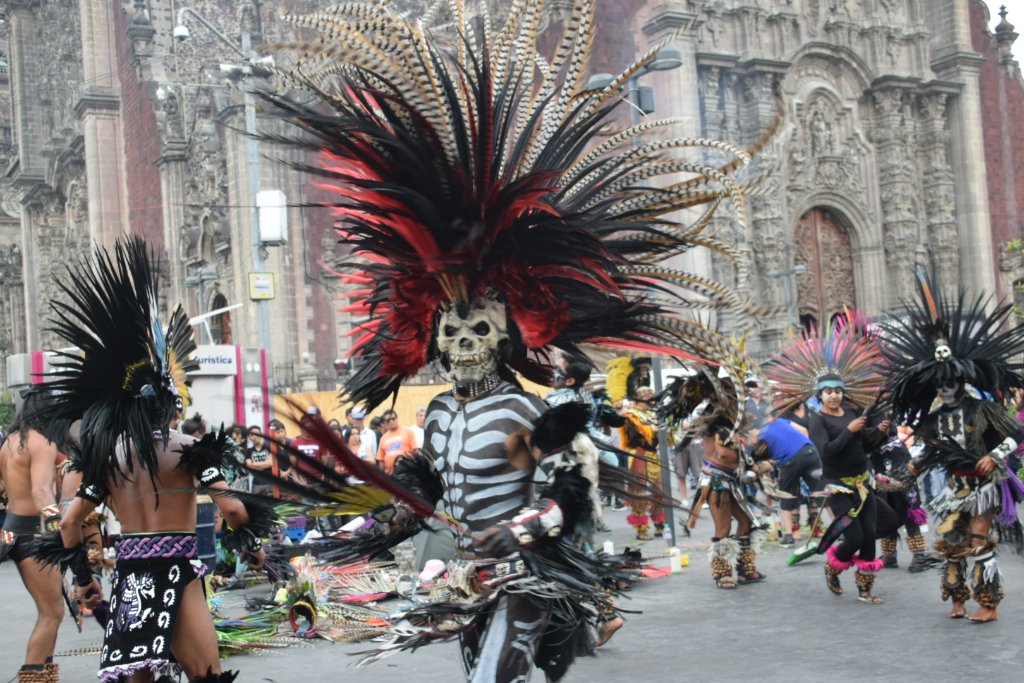
The drum hits you first.
Not metaphorically. Physically. A low, skin-stretched boom rolls across the stones of the Zocalo and lodges somewhere behind your sternum before your brain has had time to categorize it. Then the ayoyotes, seed pods lashed around ankles, hundreds of them, rattling in syncopated bursts, and you are already turning before you have decided to turn. Near the Cathedral, a half-circle of people. At the center, something that does not fit neatly into anything you already know.
This happens fast. One moment you are walking across a plaza with a coffee and a vague plan, and twenty seconds later you are standing completely still, watching, and the coffee has gone cold in your hand.
What the Concheros Actually Are
Not a performance. Not exactly. The Conchero tradition, also called Danza Azteca or Mexica, is a living ceremonial practice assembled from the wreckage of conquest. When Spanish missionaries arrived in the sixteenth century with their explicit mandate to erase indigenous religious life, the communities they were erasing did something quietly radical: they folded their pre-Hispanic rituals into Catholic feast days, disguised ceremony as celebration, kept the bones of the old world breathing inside the new one. Syncretism as survival strategy. It worked.
The name comes from the concha, an armadillo shell guitar used in the earliest iterations of the practice. What persists now is something layered and strange in the best sense — deeply indigenous in intention, movement, and costume, yet performed openly in one of the most public squares in a country built on the suppression of exactly that indigeneity. The contradiction is not accidental. It is the whole argument.
The dancers organize into mesas, each with a captain, a ritual hierarchy, years of internal protocol invisible to any outsider watching. Membership is inherited and earned over time. Children are brought into the practice early and carry it forward. When the mesas appear at the Zocalo, performing on the ground above the excavated ruins of Tenochtitlan, the Aztec capital that Mexico City was literally built on top of, the weight of that geography is not incidental. It is the whole point.
The Costumes, Which Are Not Costumes
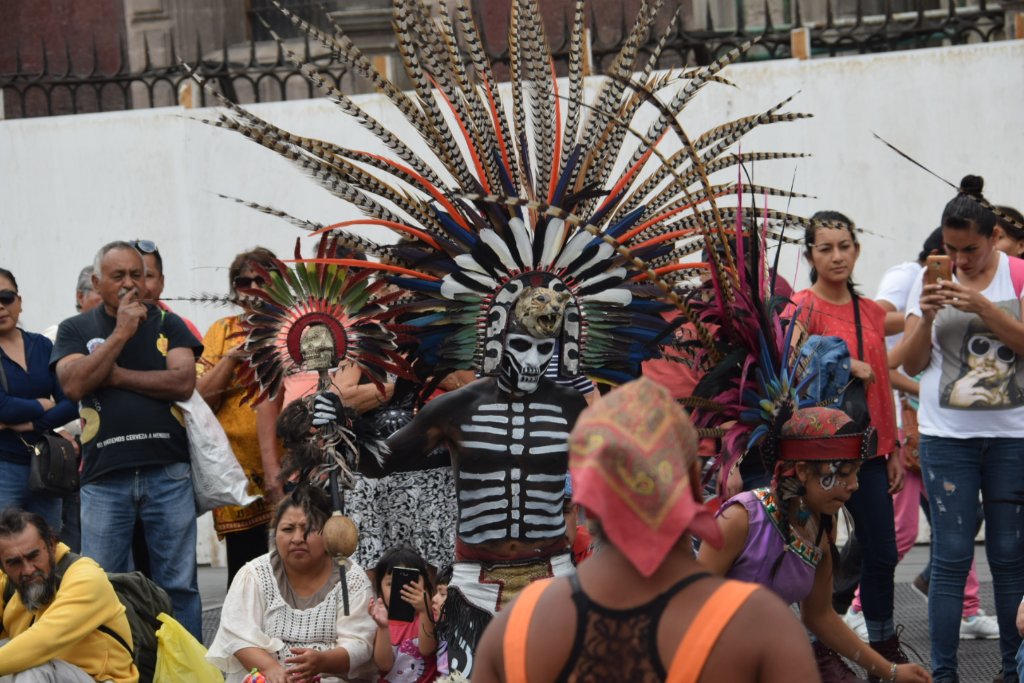
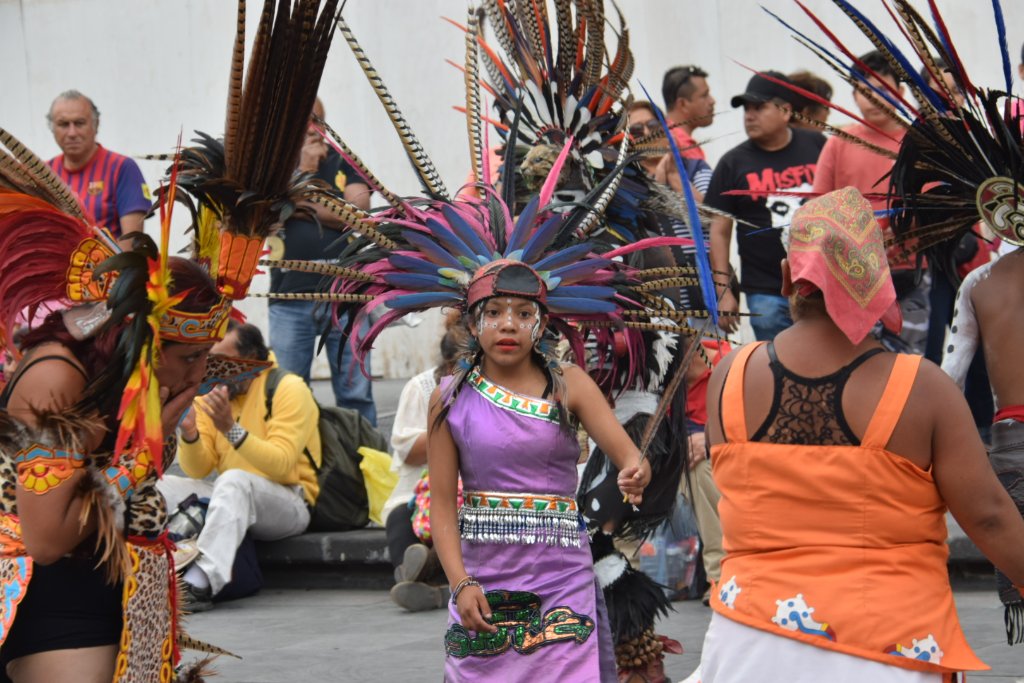
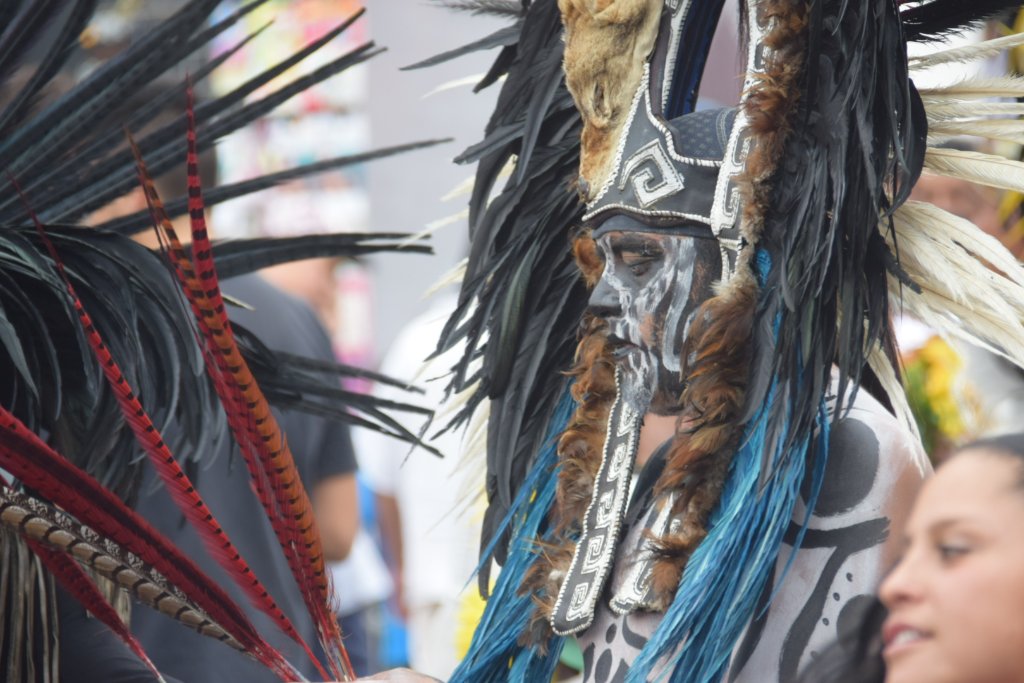
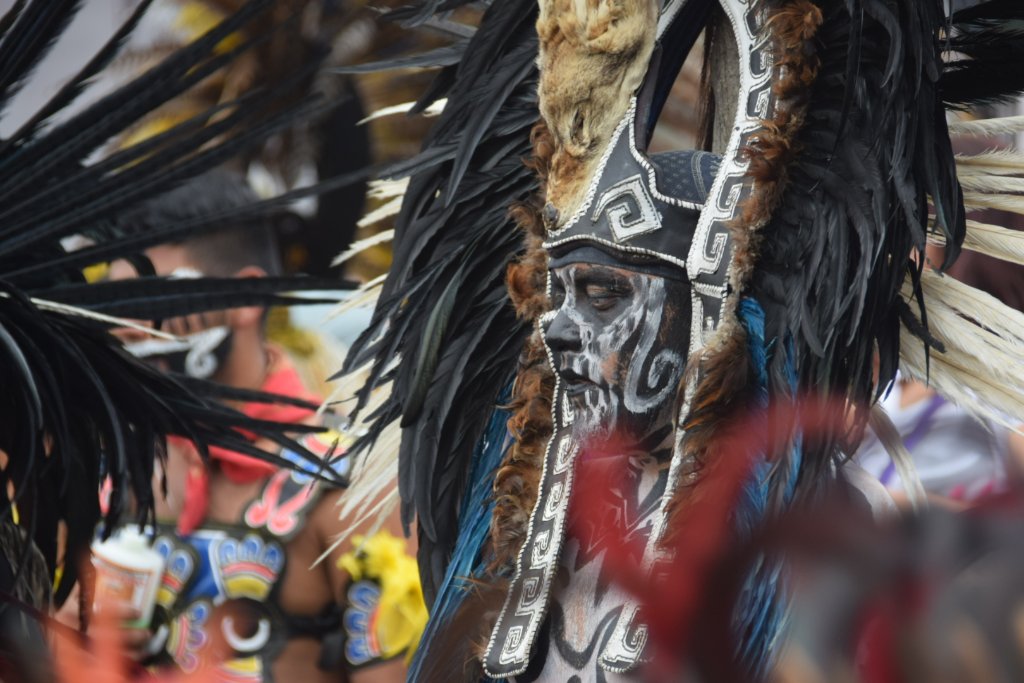
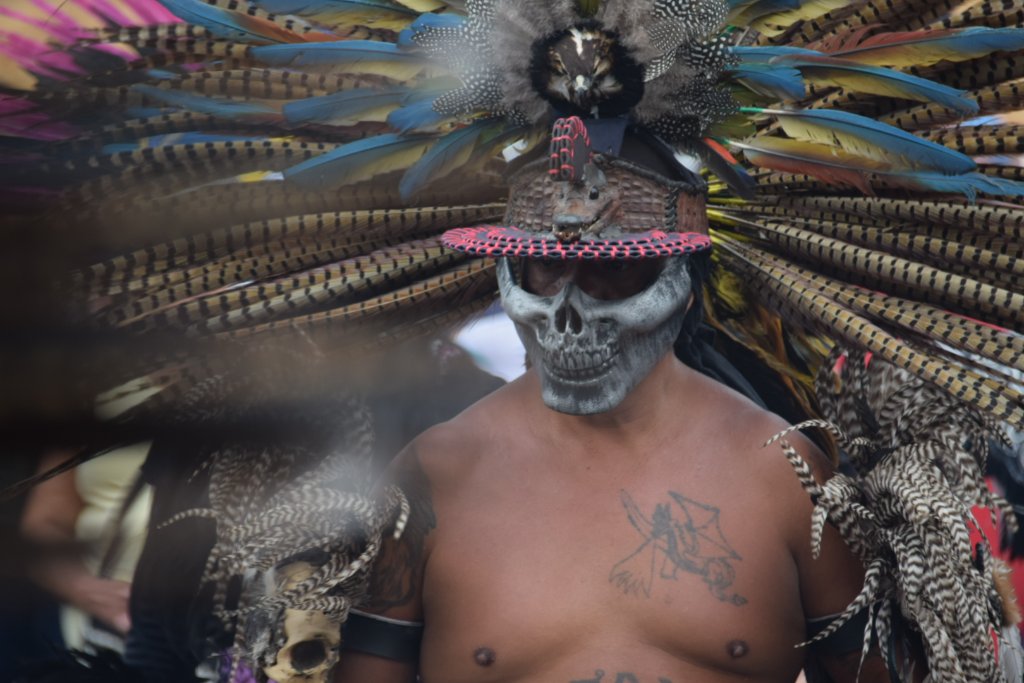
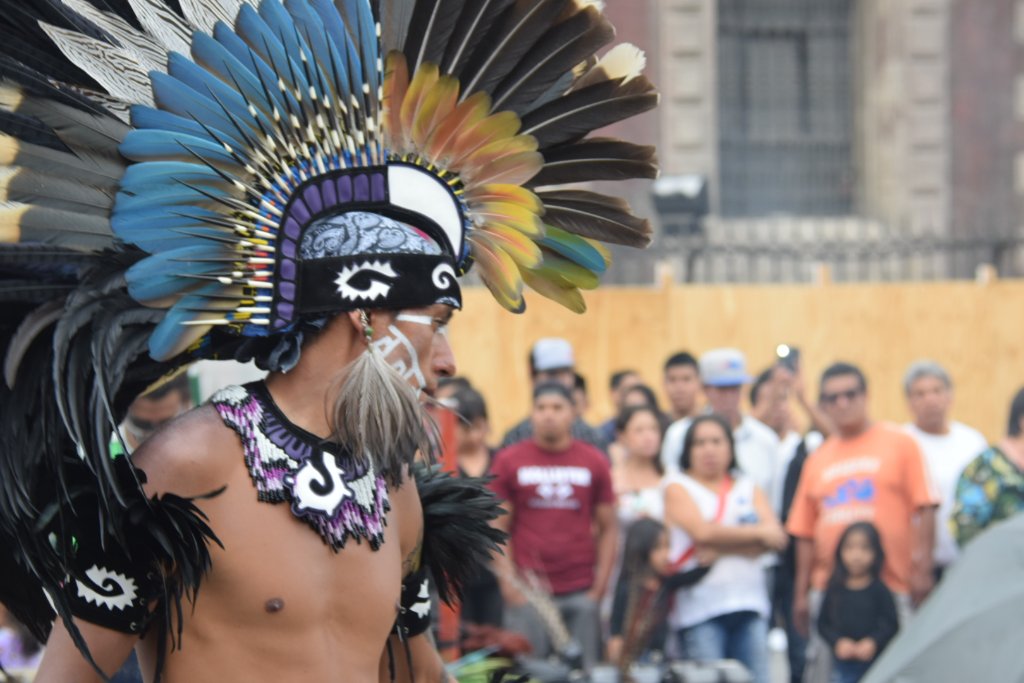
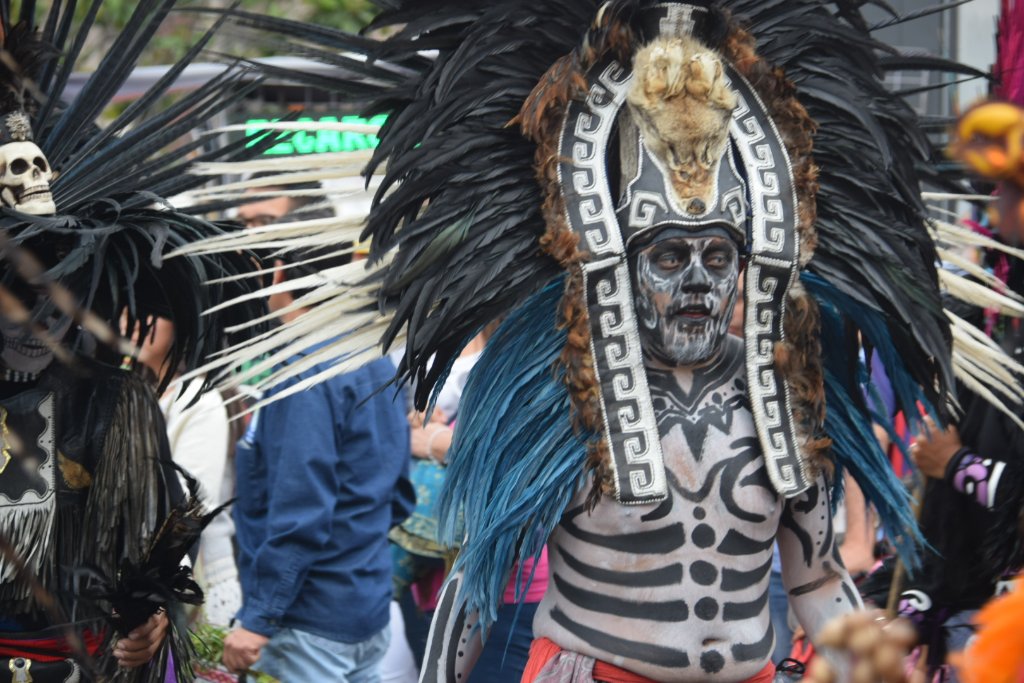
The word costume implies artifice, something worn temporarily for effect. These are not that. Each headdress, called a copilli or penacho, is handmade and specific to the dancer's role, their mesa affiliation, their family lineage in the tradition. Construction involves feathers sourced through careful channels, hand-stitched frameworks, and hours of labor that the finished piece makes invisible. Some explode outward in full radial circles: iridescent black, blood red, electric blue, gold that catches the overcast sky and throws it back differently. Others are narrower, directional, like a crest grown from the skull itself. No two are identical.
The body paint does more work than the feathers. Certain dancers cover themselves entirely in black and white, skeleton-precise, referencing Mictlan, the Aztec underworld where death and life coexist as two faces of one continuous process. This is not Day of the Dead iconography in the commercial sense. The skull imagery predates any contemporary packaging by centuries. It means something different here, heavier and older, tied to cosmologies that Spanish missionaries tried for generations to extinguish and did not manage to fully extinguish.
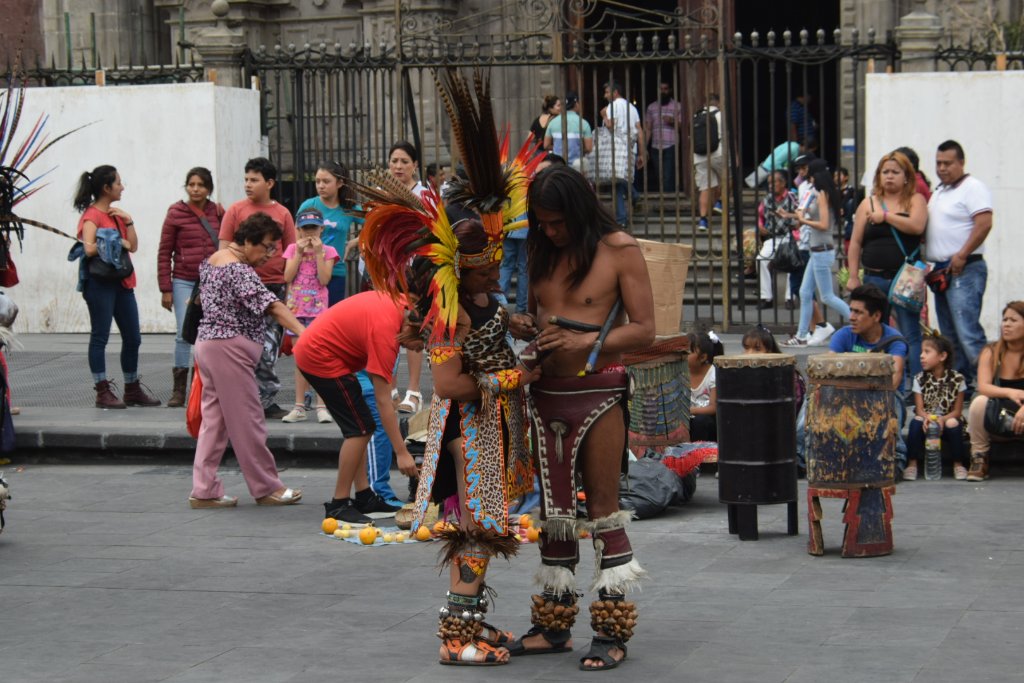
Jaguar regalia appears on some dancers, pelts, prints, wooden staffs carved with glyphs. Tezcatlipoca, one of the principal Aztec deities, associated with the night sky, sorcery, and transformation, was symbolized by the jaguar. Watching a dancer in full jaguar dress stand in front of the Palacio Nacional, which was built directly on the ruins of Moctezuma's palace, produces a specific vertigo. Five centuries of displacement compressed into a single frame that the architecture did not intend.
The Movement
Western theatrical dance wants a narrative. Rising action, climax, resolution, curtain. The Conchero form refuses this entirely. The movements are circular, stamping, recursive, feet reading a grammar written into the earth over generations, not staged for the watching. The drumming does not accompany the dance. The drumming is the engine of it. Dancers respond to rhythm the way water responds to gravity, not as a choice but as a condition.
There is no moment of showmanship aimed at the crowd. No pause for applause. The performance, if that word even applies, continues at the same intensity whether thirty people are watching or three hundred. The ceremony has its own internal logic and the crowd is incidental to it, which paradoxically makes it far more compelling to watch than anything designed with the audience in mind.
A child dances next to an elder. A girl, maybe eight years old, in a purple dress with a full penacho twice the width of her shoulders, holds the same internal focus as the adults around her. No performance face. No acknowledgment of the crowd. The Zocalo just happens to be where the mesa is, and you happen to be there too.
On Photographing This
Stay at the edge. Do not push into the performance space. Do not extend a camera into the circle. The Zocalo is public but the ceremony is not decoration, and the fact that it happens where anyone can see it does not make it a backdrop for your portfolio.
That said, the light at the Zocalo on an overcast afternoon is extraordinary for this subject. Diffuse grey skies eliminate harsh shadows and allow the feather colors to register fully without blown highlights. The Cathedral facade is always in the background, its Baroque stone a brutal and useful contrast to everything happening in front of it. Move around the perimeter slowly. Shoot from low angles when the crowd allows. The images you get at the edge, respecting the boundary, are better than anything you could get by pushing closer.
The Layers Under the Stones
The Cathedral was built using stone quarried from the Templo Mayor, the great double pyramid at the center of Tenochtitlan, the most sacred structure in the Aztec world. The Spanish did not merely build over the old city; they used the old city as raw material for the new one. The Palacio Nacional replaced Moctezuma's palace. The cathedral replaced the primary temple. The plaza was cleared over the ruins of the Aztec market and ceremonial precinct, and for four hundred years people walked across it without knowing what was underneath.
In 1978, workers laying electrical cable eight feet below street level hit carved stone. The excavation that followed uncovered the Templo Mayor itself, intact enough to reconstruct in significant detail. The museum built around the site is one of the better archaeological museums anywhere, not because of the presentation, which is functional but unremarkable, but because of the objects themselves and the specificity of their location. An artifact in a museum is always somewhat removed from meaning. An artifact found ten meters from where you are standing has a completely different relationship to the ground.
And in the plaza between the Cathedral and the Palacio Nacional, on any given weekend afternoon, Conchero dancers stamp their feet on the stone above all of it, wearing the regalia of the civilization that was dismantled to construct everything around them. Calling this complicated is accurate but insufficient. It is also alive, which is harder to explain and more important to understand.
Something that survived conquest, forced conversion, colonial erasure, and five centuries of being misunderstood by people taking photographs of it is not fragile. It has already outlasted everything that tried to stop it. Whatever you are watching on that plaza, you are watching something durable.
When to Go
Weekend afternoons, roughly noon to 5pm, give the best odds of finding the dancers. No fixed schedule exists since the mesas organize themselves independently of the city's tourism calendar. Arriving early means watching the preparation process, the dressing, the warm-up, the internal rituals that precede the public performance, which is its own thing worth seeing if you have the patience.
There is no admission charge. Some groups have donation boxes or sell small crafts; contributing is appropriate if you have spent time watching. The Zocalo Metro station on Line 2, the blue line, drops you directly at the square with no navigation required.
Combine the visit with the Templo Mayor museum next door. The ruins are visible from street level and the entry fee is modest. Give yourself a full afternoon rather than treating this as a thirty-minute detour.
The drum hits you first. After that, you stay.