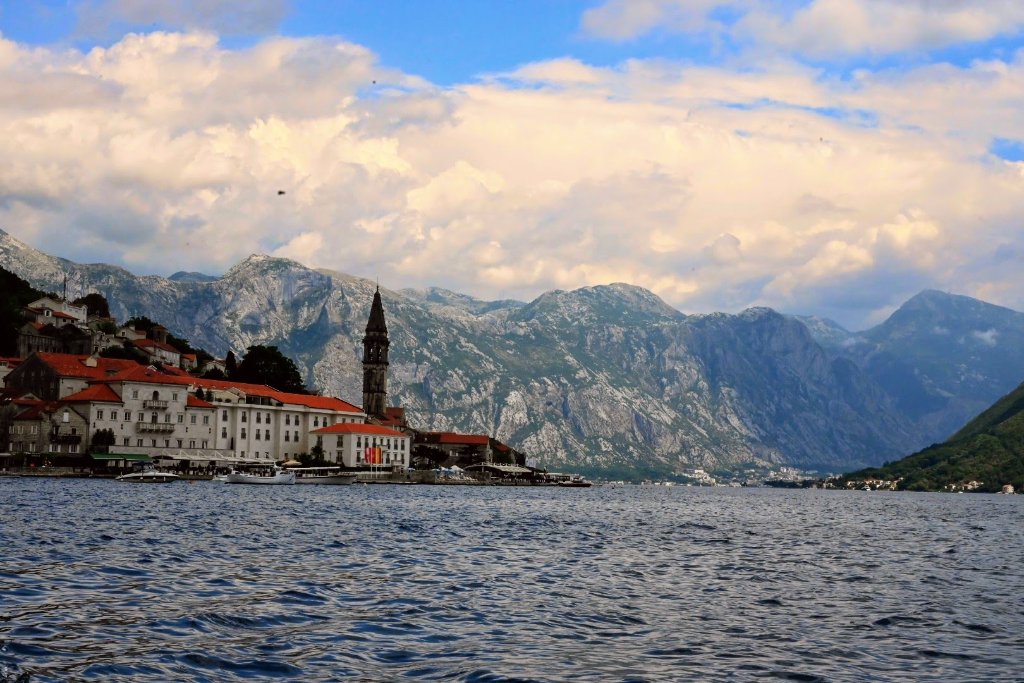
The Bay of Kotor is, technically, a fjord: a drowned river valley with limestone walls dropping straight into the Adriatic, medieval towns compressed against the waterline, and the particular quality of light that occurs when water reflects mountains reflects water in an exchange that has no obvious terminus. You have seen photographs. Everyone has. What the photographs do not convey is the scale, which is greater than you expect, or the silence in the early morning before the tour boats start, or the way the fog sits in the upper valleys for the first hour after dawn and then burns off all at once as though the decision were collective and unanimous.
I came for a week. I stayed two extra days. That is the clearest recommendation I know how to give.
Kotor: Inside the Walls
The old city of Kotor sits at the deepest point of the bay, pressed against the foot of Mount Lovćen by Venetian walls that took two centuries to build and remain intact in their entirety. The walls run from the main sea gate up the cliff face to the fortress of San Giovanni, a climb of approximately two kilometers that takes about an hour at a moderate pace and delivers you to a vantage point where the entire bay is visible: the inner bay, the outer bay, the narrow channel at Verige where the water narrows to a few hundred meters before widening again, the island churches sitting on their small plots of reclaimed ground, the mountains on every side going straight into cloud.

The old city itself is small enough to understand in an afternoon. The main square, Trg od Oruzja, is the social center: cafe tables, the Cathedral of Saint Tryphon with its asymmetrical towers, occasional wedding parties emerging from one or the other entrance with the particular expression of people who have just survived a ceremony. The lanes off the square narrow quickly and become genuinely labyrinthine, which is not a figure of speech; I got turned around repeatedly in a space that is maybe five hundred meters across, because the lanes curve and double back and open onto small courtyards that connect to other lanes at unexpected angles.
The cats are everywhere, which Kotor is famous for, and which are the subject of an inexplicable volume of dedicated merchandise in every shop. The cats live in the walls, literally, in the gaps and crannies of the Venetian stonework. They are not pets. They belong to the city in some older, less domesticated sense of the word. There is a cat museum on one of the upper lanes that I visited out of curiosity and left with a better understanding of why some places develop specific animal mythologies and others do not.

Perast: One Street, Two Islands
Twenty minutes north by car or a longer and more pleasurable journey by the local boat service that connects the bay towns, Perast is a single-street settlement of extraordinary Baroque architecture on a narrow strip of land between the mountain and the water. In the seventeenth and eighteenth centuries, when the Venetian Republic controlled the Bay of Kotor and the trade routes passing through it, Perast was home to one of the most important nautical academies in the Adriatic. Russian officers trained here under Peter the Great's naval reform program. The town was prosperous enough to build sixteen churches for a population that never exceeded a few thousand people, which produces a ratio of devotional architecture to inhabitants that suggests either exceptional piety or exceptional competition between patrons.

Most of those churches are in various states of decay now, their interiors inaccessible without connections or persistence. The frescoes in certain neglected interiors are better in their ruin than they would be fully restored, the peeling surfaces revealing layers of paint over earlier paint, a stratigraphic record of devotion that the conservation process would necessarily flatten.
The two islands visible from the Perast waterfront are both occupied and both worth getting to by water taxi. Sveti Đorđe, the natural island, holds a Benedictine monastery that does not generally receive visitors. Our Lady of the Rocks is the artificial one, accumulated over centuries by the tradition of Perast sailors dropping stones into the water as they passed a reef where, according to local account, two fishermen found an icon of the Madonna in 1452 and interpreted this as an instruction to build.

The church on the island holds the icon, several hundred silver votive tablets hammered into the shapes of ships and body parts and other objects sailors prayed about, and an embroidery created over twenty-five years by a local woman named Jacinta Kunić-Mijović using, in addition to conventional thread, her own hair. Her hair turned grey as she worked over those twenty-five years. Both colors are present in the finished piece, which is a document of time passing as much as it is a devotional object.

The Drive Around the Bay
The road that circuits the inner Bay of Kotor is not a drive you do for speed. It is a drive you do for the accumulated effect of moving through a landscape that is this specific and this beautiful for this many continuous kilometers. The road is narrow, the towns are frequent, and the trucks coming from the opposite direction require a negotiation of space that keeps your attention fully present in a way that highway driving does not.

The Verige Channel crossing, where car ferries run every thirty minutes between two points separated by fifty meters of water and thirty kilometers of road, is worth taking even with no particular destination on the other side. You stand on the ferry deck for four minutes. The bay opens behind you and closes in front of you. Then you are on the Luštica Peninsula, where the development is thinner and the coves are quieter and the beaches are empty after September.
The peninsula road is unpaved in stretches and rewards slow driving. The olive groves on the hillsides above the western coast are old, centuries old in places, the trunks thick and gnarled and completely indifferent to being picturesque.

The olive oil from Luštica is sold in Herceg Novi at the Sunday market and is better than you expect from an oil you have never heard of.
Herceg Novi: Where the Bay Meets the Open Sea
At the mouth of the bay, where the enclosed fjord psychology evaporates and the Adriatic opens out, Herceg Novi occupies a steep hillside with staircases in place of streets and three or four historical layers visible in every block. Spanish fortress, Ottoman addition, Austro-Hungarian promenade, Yugoslav-era apartment buildings: all occupied, all functional, none of it apologizing for the mixture.

The Sunday market on the lower promenade runs along the waterfront with a directness that farmers markets in wealthier countries have mostly lost. Local honey in several varieties, sold in unlabeled jars by the beekeeper. Mountain cheeses wrapped in cloth. Small dried figs specific to the Boka Bay region, intensely sweet, sold by the bag. Olive oil from Luštica. The vendors are not performing authenticity; they are selling what they make to people who will eat it.
I bought more than I could reasonably carry and redistributed most of it to the woman running my guesthouse, who accepted the olive oil and returned the figs as beneath consideration, which told me something about local quality standards I could not have learned from a review.
When to Go
September and October are the correct months. The summer crowds have cleared, the water temperature is still adequate for swimming, the light in the late afternoon is the best light of the year, and the old city of Kotor is manageable rather than impossible. In July and August the walled city fills completely and movement through the lanes becomes a negotiation. In October it is yours in the early morning and the late evening and, on weekdays, most of the hours between.
Driving is necessary unless you have unusual patience for infrequent buses and incomplete coverage of the smaller towns. A rental car from Tivat airport, the closest airport to Kotor, allows you to follow the bay road at your own pace, stop where the light is right, take the Verige ferry on a whim, reach Perast without consulting a schedule.
In November, the bay towns become very quiet. The restaurants that depend on summer trade close. The ones that remain open are the ones run by people who live there year-round, which is the best possible filter.